


© Andrej Grilc
News

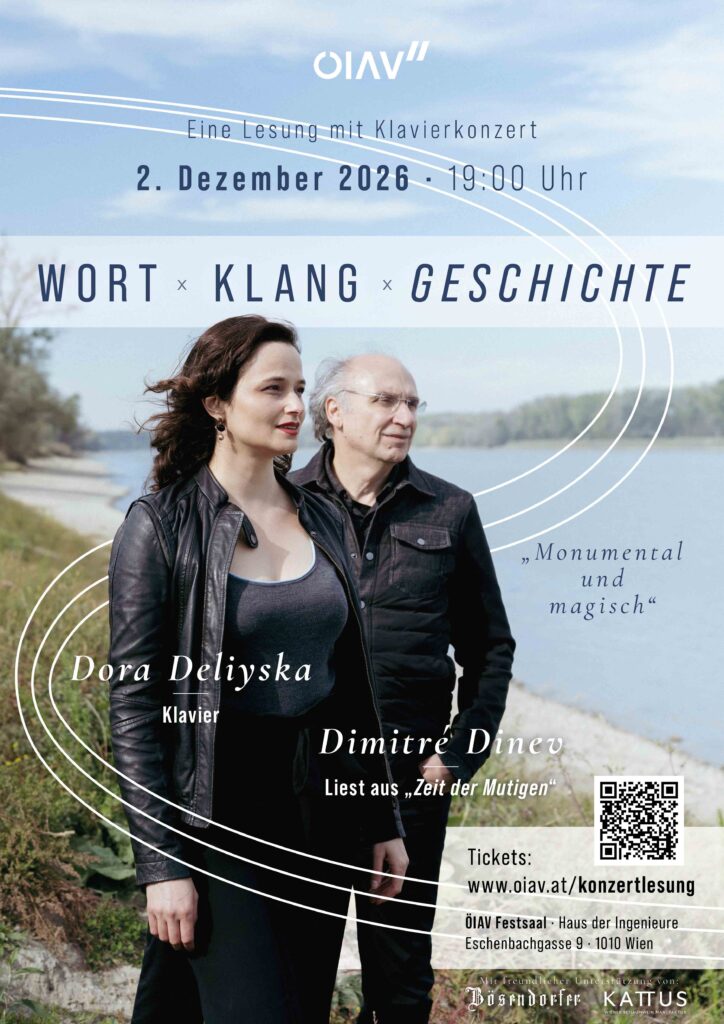
Word x Sound x Story
02.12.2026 | 7:00 pm
A Reading with a Piano Concert
Read more + -
Reading a book is a very intimate process. One immerses oneself in a world that has its own framework, its own structure and emotional depth. While engaging with the plot and the characters, one becomes absorbed – almost unconsciously – in one’s inner world and reflects on one’s own thoughts. My aim in creating the musical programme was to transform this reflection into a musical structure that mirrors my reading of Dimitré Dinev’s book *Zeit der Mutigen*.
In order not to interrupt the melody of the text or interfere with the completeness of the subject matter, I created four sections that form a wave-like structure. The text flows between them like a river (like the Danube). In this way, the two components – word and sound – merge on stage, giving rise to a unique body of sound.
To create the four parts of the programme, I used recurring leitmotifs from the book, each of which carries its own musical line. One example is the leitmotif of the fire that must never be extinguished, ‘so that those who have lost their way in the darkness may find their way to another human being’ (p. 206), ‘which promised protection to anyone who had lost their way’. From a musical perspective, it is reminiscent of a theme with variations. For this, I used the main theme from Schubert’s String Quartet in D minor and created my own piano arrangement of it. On one occasion, Schubert’s symbolically significant theme ‘Death and the Maiden’, which also appears in his song of the same name to a text by Goethe, is heard as a theme with two variations, and on another occasion simply as a theme and coda (beginning–end).
I found another significant source of inspiration in the combination of letters SCH, which appears in the recurring motif ‘Schweiß, Schmerz und Schlaf’ (sweat, pain and sleep). To reflect these letters, I used Shostakovich’s Preludes and Fugues. Together with the first letter of his first name (Dmitry), this forms the famous DSCH motif, one of the best-known cryptograms in music history, through which the composer Dmitry Shostakovich immortalised himself. He had to compose some of his Preludes and Fugues in secret and, despite being condemned by the Party, succeeded in composing one of the most important piano cycles of the 20th century. In conjunction with Bach’s *The Well-Tempered Clavier*, written 200 years earlier, these works form an uninterrupted musical line that transcends the boundaries of time.
I also found a beautiful musical and literary connection between the leitmotif of the Czech song (quote: ‘which made all the things he loved seem closer’ or ‘so that the young soul would not be afraid of this world’) and Janáček’s piano piece *In the Mists*. The Czech song in the book often serves as an oasis of calm, a refuge from fate and a way of expressing the inner voice without fully understanding the words. In his composition, Janáček creates a musical structure consisting of four parts and, through his versatility, gives shape to the so-called ‘polyphony of emotions’ (Milan Kundera, University of Miami). A term that could also be applied to the book.
For the conclusion of the programme, I chose Balakirev’s *Islamey*. For a long time, it was considered one of the most demanding works in the piano repertoire. With its extreme emotions and technical challenges, the piece represents a symbolic culmination of emotions. It is my personal interpretation of liberation from oppression, which frequently appears in the book’s subject matter – for example, in relation to fate or the political regime.
Dimitré Dinev’s book has deeply moved and inspired me. In its completeness, I sought ways to transform recurring leitmotifs, musical and literary ideas, and sometimes even letters into a musical structure. Through this symbiosis of word and sound, an independent work of art emerges on stage, allowing listeners to engage in their own reflection in the here and now.

New Video
live from the Vienna Konzerthaus
J.S.Bach, Prelude in C-Sharp Major, BWV 848

© Lukas Heistinger
New Release – “Encore!“
20.02.2026
The encore arises in the space between sound and silence
Read more + -
In her latest programme, Encore!, Dora Deliyska considers the encore not only as the conclusion of a concert, but also as a transition between the performance and the silence that follows.
The pieces are arranged in an order that creates a musical structure consisting of three parts. The first part consists of four works by Schubert, whose keys form a diminished seventh chord.
The second part forms an island of calm with works by Arvo Pärt and Johann Sebastian Bach. In the many passages with different pianissimo nuances, the piano is experienced not only as a keyboard instrument, but also as a sound box capable of producing an incredible range of acoustic colours.
The third part of the programme unfolds the concept of romantic and virtuoso encores. Emotional highlights such as Liszt’s Liebestraum and Kreisler/Rachmaninov’s Liebesleid alternate. Finally, spirited pieces by Fazil Say bring the concert to a brilliant conclusion.
The encore arises in the space between sound and silence. It is the moment when the concert has ended and emotions have reached their peak. But then another piece begins to play – uncertain, unexpected, surprising! It is precisely this uncertainty that gives the encore its special power: it can abruptly steer the emotions of the concert evening in opposite directions and either continue what has been presented so far or create a strong contrast.
The encore is the last word, the final message that the musicians give to the audience.


© Lukas Heistinger
Dora Deliyska in an interview with pizzicato
27.02.2026
The encore is the transition between the musical universe and reality

© Lukas Heistinger
New Photo Shooting with the artist Lukas Heistinger
Ligeti on 8 pianos
Read more + -
The video piece “Pulsations” is based on the étude “Fanfares” by Ligeti. Dora Deliyska, Axel Stockburger and Kai Maier-Rothe created and filmed this piece 2018 in the Bösendorfer piano factory in Austria using 8 Bösendorfer grand pianos. The concept is based on the rhythmic structure of the piece and how it transposed into a spatial arrangement of the different pianos. Credits: Dora Deliyska: Piano based on György Ligeti – Études 4: Fanfares (1985) Kai Maier-Rothe & Axel Stockburger: concept, sound, camera, postproduction funded by Bundeskanzleramt Österreich, Kunst kindly supported by Bösendorfer Pianos More about the concept: Initially, Ligeti’s specific approach to the enormous complexity of African Polyrhythms drew us towards this musical piece. He wrote, “a completely different metric ambiguity occurs in African music. Here there are no measures in the European sense, but instead two rhythmic levels: a ground layer of fast, even pulsations, which are not counted as such but rather felt, and a superimposed, upper layer of occasionally symmetrical, but more often asymmetrical patterns of varying length”. In: Arom, Simha (1991) African polyphony and polyrhythm: Musical structure and methodology, Cambridge University Press, Cambridge UK.

“Only by taking strong decisions and risking one can reach new artistic grounds“
26.06.2025
Performance at the Summer Festival in Varna with the Kreisler Trio, Vienna

Debut in a duo with violinist Mario Hossen
20.05.2025
At the opening of the Balabanov’s House Chamber Music Festival in Plovdiv, Bulgaria

© ORF/ Ursula Hummer-Berger
Dora Deliyska as a radio host at the leading cultural radio station in Austria – Ö1
10.07.2024 | 8:20 am
Read more + -
Dora Deliyska is an internationally acclaimed pianist who has already released several fascinating concept albums. She creates concert programs and combines elements that do not necessarily appear to belong together. This creates a dramaturgy that allows the audience to experience completely new musical contexts. One can hear her artistic approach in the radio program “Pasticcio-Sommerfrische”.
TED Talk on the thin line between piano performing art and science
08.06.2024
Klagenfurt
© TEDx Klagenfurt
The power of piano performing art and my personal story

© Manuel Bacher
Poème Symphonique for 100 metronomes
09. – 11.02.2024
Dora Deliyska interprets Ligeti as part of a sound installation, together with the artist Patricia J. Reis
“Études & Préludes” twice at the Vienna Konzerthaus
19.10. & 20.10.2023
Dora Deliyska opens up new listening experiences

© Andrej Grilc
“The whole is greater than the sum of its parts.”
13.02.2023
A conversation with Alain Steffen


© Jennifer Gelardo
Pre-Release Talk Concert at the Konzerthaus
19.01.2023
Dora Deliyska and Christoph Wellner, editor-in-chief of Radio Klassik Stephansdom and musicologist talk about the concept and the genesis of “Études & Préludes”

MORE NEWS + -


© Alexander Bogdan Thompson
Dora Deliyska appointed artist in Residence for the Season 2021/2022 in State Opera Plovdiv
01.09.2021

Dora Deliyska to record in Teldex Studio, Berlin
09.08.2021

© Daniel Waldhecker | Kobalt Productions GmbH
Daniel Hope and Dora Deliyska at Europe@home for ARTE TV
26.02.2021 | 7.00 pm
Live-Stream on ARTE TV
The pianist Dora Deliyska is a guest on “Europe@Home” on Arte TV and presents the musical diversity of her home country Bulgaria. She also plays pieces from her latest CD “Alles Walzer, einmal anders!” and thus shows her close connection to the Viennese sound tradition.

© Alexander Bogdan Thompson
“Metamorphosen” for piano and Orchestra to premiere in November
31.10.2021
Dora Deliyska’s develops conceptual programm, first time for piano and orchestra. Including monumental pieces, such as Liszt Totentanz and Rachmaninov, Paganini Variations the pianist reache new sound structures and unites the program with the “Dies Irae” theme
© Andrej Grilc
Dora Deliyska
Artist’s biography
In recent years, Dora Deliyska has established herself not only as one of the leading, but also most versatile and interesting pianists of the present day. Her self-developed artistic projects have their own dramaturgy and cast a new and unique perspective on piano literature and the art of interpretation.
Through years of concert performances as well as audio and video recordings, Dora Deliyska has garnered international critical and audience acclaim. Her extensive repertoire ranges from Bach to Ligeti. She creates a connection between sensitive piano interpretation, precise virtuosity and well-founded musicological debate.

Dora Deliyska is a Bösendorfer Artist.
Programs
Alles Walzer, einmal anders!
With her most recent release, “Alles Walzer, einmal anders!”, Dora Deliyska enables her listeners to experience the Viennese waltz in an altogether different way. The pianist constructs complexities on the basic structure of this dance and shows the waltz in its myriad of facets: From Viennese-elegant to modern, virtuosic, orchestral; even impressionist. A Viennese newspaper named the CD as one of Austria’s Top 10 cultural events in 2020.
Études & Préludes
There are several important piano cycles that consist of 24 pieces. Composers have always liked drawing on this straightforward structure. So does Dora Deliyska – and combines and juxtaposes twelve Etudes and twelve Preludes by composers Frédéric Chopin, Claude Debussy, György Ligeti, and Nikolai Kapustin. The first part is made up of twelve hand-picked Etudes that are arranged by interval, going from a second all the way to the octave, intensifying emotionally with each step. The twelve Preludes of the second part mirror the first half and bring into balance the recital program which – greater than the sum of its 24 individual parts – could be seen as an artwork in and of itself.
B-A-C-H
The idea of the whole being more than the sum of its parts is made tangible by Dora Deliyska’s B-A-C-H Project. The Viennese-trained, Bulgarian-born pianist manages to combine excerpts from Bach’s WellTempered Clavier with corresponding selections from Shostakovich’s Preludes and Fugues op.87 and Chopin Etudes in such a way that the collection becomes an artwork itself.
Frank Siebert
Encore!
The encore arises in the space between sound and silence. It is the moment when the concert has ended and emotions have reached their peak. But then another piece begins to play – uncertain, unexpected, surprising! It is precisely this uncertainty that gives the encore its special power: it can abruptly steer the emotions of the concert evening in opposite directions and either continue what has been presented so far or create a strong contrast.
The encore is the last word, the final message that the musicians give to the audience.
Dates
02
December
Wien | Lesung und Klavier
DORA DELIYSKA UND DIMITRÉ DINEV
HAUS DER INGENIEURE, WIEN
24
–
27
February
Vorarlberg | Prima la Musica
JURYTÄTIGKEIT, KLAVIER KAMMERMUSIK
VORARLBERG
05
April
Wien | Benefizkonzert
DORA DELIYSKA, LIDIA BAICH, WOLFGANG HÄRTEL
EHRBAR SAAL, WIEN
12
April
Sofia | Mozart Concerto
CLASSIC FM ORCHESTRA
GEORGI DIMITROV
SOFIA, BULGARIEN
09
July
Bad Ischl | Kirchklang
BEETHOVEN REZITAL MIT DEM GEIGER MARIO HOSSEN
BAD ISCHL


Sorry, no posts matched your criteria.
Supporters and sponsors


